One seed phrase is a single point of failure. Multisig is the fix.
Fire, theft, a phishing page, your own memory — with a single seed, one event can wipe out everything. There is a better architecture, and in 2026 it no longer requires being a developer.
Short answer
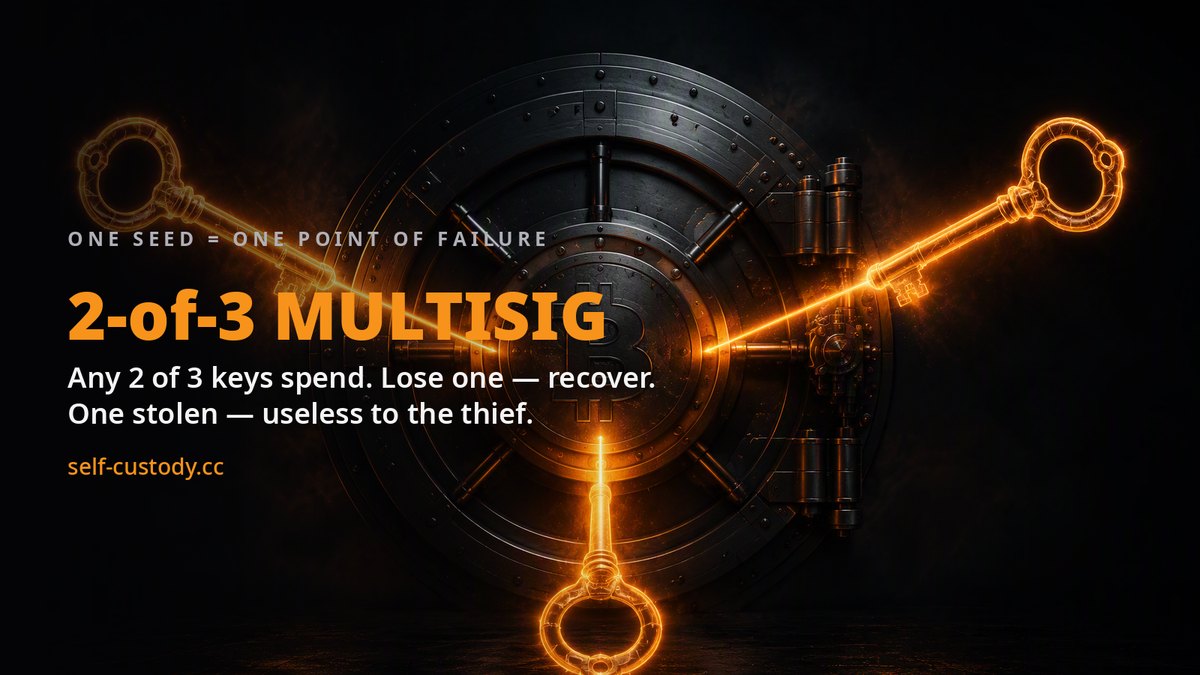
A single seed phrase can be destroyed by one fire, one theft, one clever phishing page or one lapse of memory — and then your bitcoin is gone forever. A 2-of-3 multisig removes that single point of failure: three keys, any two spend. Losing one key is recoverable; a stolen key is useless to the thief. It costs you setup time and backup discipline — and buys you the closest thing to a complete answer self-custody has.
The uncomfortable truth about one seed phrase
Every single-signature wallet — hardware, mobile, whatever — collapses to one secret: the seed phrase. Whoever has it has the coins. Whatever destroys it destroys the coins. Think about how many single events can take it out:
- Fire or flood. Paper burns, and even steel can be lost in rubble you never get access to again.
- Theft. A burglar, a border agent, a “trusted” house guest — one photographed napkin is a total loss.
- Phishing. One convincing “wallet update” page, one moment of hurry, twelve words typed — gone in minutes.
- Your own memory. The passphrase you were sure you’d never forget, the hiding spot that was too clever, the heir who has no idea where to look.
None of these are exotic. They are the everyday ways people actually lose bitcoin — not hackers in hoodies, but entropy and life. The industry’s answer was always “be more careful.” Engineering has a better one: stop having a single point of failure.
How 2-of-3 multisig works
A multisig wallet is created from three independent keys, and its spending rule is simple: any 2 of the 3 keys must sign. Not one, not all three — any two. That one change rewires the entire failure table:
| Event | Single seed wallet | 2-of-3 multisig |
|---|---|---|
| One key lost or destroyed | Funds gone forever | Recoverable — the other two keys still spend |
| One key stolen | Funds gone in minutes | Useless to the thief — one key cannot sign alone |
| One location burns down | Total loss if the backup was there | Inconvenient, not fatal |
| Coercion / $5 wrench attack | Hand over one phrase, lose everything | You physically cannot comply alone |
No single event, device, location or person — including you, on your worst day — can cost you your coins. That is the entire point.
Why multi-vendor is the strongest setup
Three keys from the same manufacturer reintroduce the single point of failure through the back door. Correlated failures are the silent killer: one firmware bug, one compromised shipment, one seed-extraction exploit — and all three of your “independent” keys fail the same way at the same time.
The robust setup is deliberately diverse — for example Trezor + Blockstream Jade + Keystone: different manufacturers, different firmware stacks, different secure elements, different supply chains, different jurisdictions. A backdoor in one vendor’s code, a bad batch from one factory, a legal order against one company — none of it touches your wallet, because two honest keys still outvote one compromised key. Diversity is the defense. Pick the three devices in our hardware wallet comparison.
Coordination is solved: Sparrow and Nunchuk
Multisig used to be a command-line ritual for developers. Not anymore. Sparrow (desktop) coordinates the vault — descriptors, PSBTs, air-gapped signing flows, full transaction inspection. Nunchuk (mobile) adds a pocket signer and guided, assisted multisig for less technical family members. Both speak the same descriptor standard, so keys move freely between them. We compared them in detail: Sparrow vs Nunchuk — spoiler, the best answer is both.
The backup strategy: redundancy without fragility
A multisig backup has four parts, and their separation is the design:
- Three seeds — each stamped in steel, each in a different location. No two in the same place.
- The wallet descriptor — the three xpubs and derivation paths that define the wallet. Store a copy with each seed.
- The math that makes it safe: the descriptor alone cannot spend. One seed alone cannot spend. Any two seeds plus the descriptor can. So no single location, if breached or destroyed, can lose or steal the funds — yet any two locations can always recover them.
- Generate each seed with dice — 99 rolls, verified by hand — so no device’s RNG is part of your trust chain.
Inheritance: the underrated superpower
Ask yourself the hard question: if a bus wins tomorrow, does your bitcoin die with you? With a single seed — probably yes. Multisig changes the answer two ways. The DIY path: an inheritance letter that tells your heirs who to contact, where the pieces are and how recovery works — without containing any secret itself. The assisted path: Nunchuk’s inheritance workflows, with time-locked recovery and key handover designed for exactly this event. Either way, your family can recover without you ever sharing a key during your lifetime. Our multisig guide includes inheritance templates.
The honest trade-offs
- Setup time. An evening, done slowly and carefully — versus twenty minutes for a single-sig.
- Backup discipline. Three seeds plus descriptors, three locations, periodic checks. More moving parts to maintain.
- Spending friction. Two signatures mean two devices and, sometimes, two places. This is a vault, not a wallet for coffee.
- Cost. Two or three hardware devices instead of one.
So be deliberate about scope: multisig is for serious, long-term savings — the stack that would change your life if lost. Keep a small single-sig hot wallet for daily spending, and graduate to multisig when the number starts to matter. Start small, drill a full recovery with a test amount, then move the real funds.
Frequently asked questions
Is 2-of-3 multisig better than a single seed phrase?
For long-term savings, yes. A single seed is one secret that fire, theft, phishing or forgetfulness can destroy or expose in a single event. In 2-of-3 multisig, losing one key is recoverable and stealing one key is useless — no single event can cost you your coins.
What happens if I lose one key in a 2-of-3 multisig?
Nothing is lost. The remaining two keys can still sign and move the funds to a fresh wallet. You then replace the lost key and redistribute backups — an inconvenience, not a catastrophe.
Why not three hardware wallets from the same brand?
Because failures correlate: the same firmware bug, compromised shipment or seed-extraction exploit would hit all three devices at once. Multi-vendor setups (e.g. Trezor + Jade + Keystone) make one vendor’s failure survivable.
Do I need to be technical to set up multisig?
No. Wallets like Sparrow (desktop) and Nunchuk (mobile) handle descriptors, PSBTs and signing flows with a guided UI. If you can set up a hardware wallet, you can set up a 2-of-3 multisig in an evening.
When should I upgrade from single-sig to multisig?
When the amount would genuinely change your life if lost. Below that, a single hardware wallet with a steel backup and passphrase is reasonable. Above it, the extra cost and discipline of multisig is cheap insurance.